
Durham reservoirs fall to 27% as drought worsens and water purchases top $4 million
Durham has 76 days of readily accessible reservoir water remaining, while the city has spent more than $4.1 million supplementing its supply with water from Cary and OWASA.

 Wes Platt

Durham’s reservoirs have fallen another percentage point, the latest U.S. Drought Monitor shows worsening conditions across the Southeast, and the city’s drought response has now come with a multimillion-dollar price tag.
As of Nov. 17, Lake Michie and Little River Reservoir were at a combined 27% of capacity, down from 28% in our previous update.
Durham estimates it has 76 days of readily accessible reservoir water remaining, down from 77 days. But lower average demand continues to stretch the overall supply: the city still estimates it has 148 total days of water available when harder-to-access reservoir water and emergency storage at Teer Quarry are included.
By the numbers
The continuing decline in average demand is important. Durham’s reservoirs are still losing stored water, but the city is drawing less from them, allowing the estimated total supply to remain steady.
Durham has spent more than $4.1 million buying water
That breathing room isn’t coming from conservation alone.
Durham has spent $4.16 million on supplemental water from Cary and the Orange Water and Sewer Authority since the drought response began, according to city figures obtained by WRAL.
 Destinee Patterson, WRAL Enterprise Reporter
Invoices received so far show Durham paid Cary:
- $235,591.36 in June
- $795,899.20 in July
- $883,966.40 in August
- $788,558.72 in September
- $1,248,085.76 in October
That comes to $3.95 million paid to Cary. Durham also has been billed $211,341 for water purchased from OWASA, bringing the combined total to $4,163,442.44.
Those invoices cover about 852 million gallons from Cary and 46 million gallons from OWASA, or roughly 898 million gallons altogether. November invoices hadn’t yet arrived when the city provided the figures, meaning the eventual total will be higher.
There’s an important distinction with the Cary water: Durham isn’t simply buying someone else’s reservoir supply.
Durham has an allocation of up to 16.5 million gallons per day from Jordan Lake, but it doesn’t yet have the infrastructure to withdraw and treat that water itself. Cary treats part of Durham’s allocation at the Cary-Apex water treatment plant and sends it to Durham through interconnected water systems. Cary currently is providing roughly 9 million gallons per day.
Durham water officials estimate those Cary purchases alone have added roughly 30 to 35 days to the city’s available supply during the drought.
The city resumed buying about 2 million gallons per day from OWASA on Nov. 2, after purchasing water from the utility during July and August and then pausing those purchases. Durham also continues drawing roughly 3 million to 4 million gallons per day from Teer Quarry.
Water Management is funded through water and sewer rates rather than property taxes. City spokesman Joe Lunne told WRAL that officials don’t expect the supplemental-water purchases by themselves to have a significant effect on future rate increases, which are driven more heavily by long-term capital, operations, and maintenance costs.
The Drought Monitor isn’t showing relief
The broader drought picture isn’t getting better either.
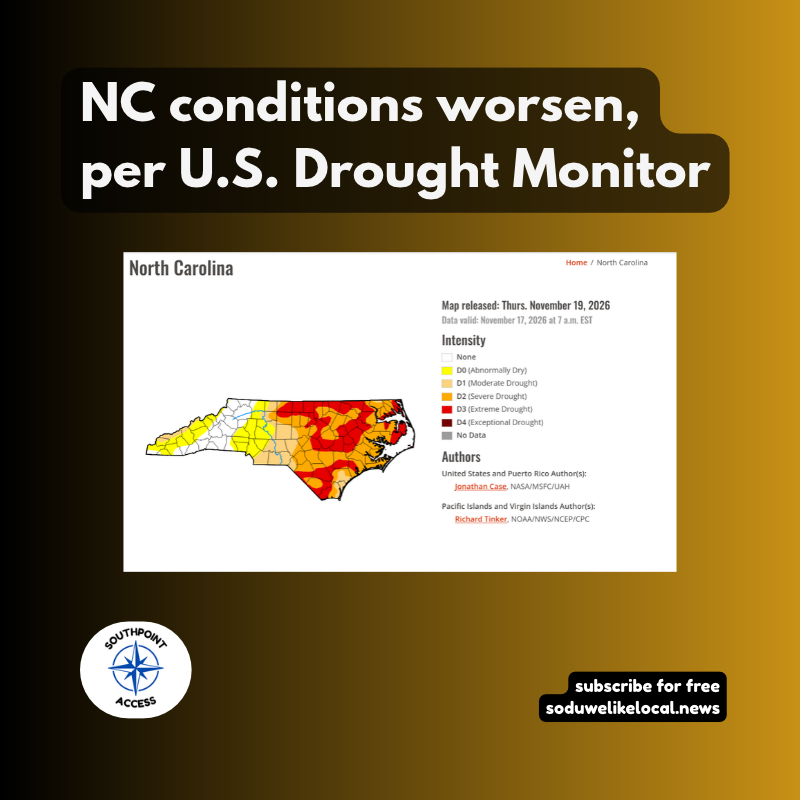
The U.S. Drought Monitor released Thursday, Nov. 19, uses conditions observed through Tuesday, Nov. 17. Its national summary described generally worsening drought conditions from the Mississippi River Valley through the Southeast and into the Middle Atlantic states.
Durham County remains entirely affected by drought. Drought.gov reports that 100% of the county’s population — about 267,600 people — is living in an area classified as drought, with January through October ranking as the 13th-driest such period in 132 years of records. Rainfall during that period was about 8.69 inches below normal.
Those broader numbers line up with what Durham residents can see in the city’s reservoirs.
Lake Michie has received only 0.21 inches of rain during November, while Little River Reservoir has received just 0.16 inches.
Now, two chances for rain
There is at least something new in the forecast.
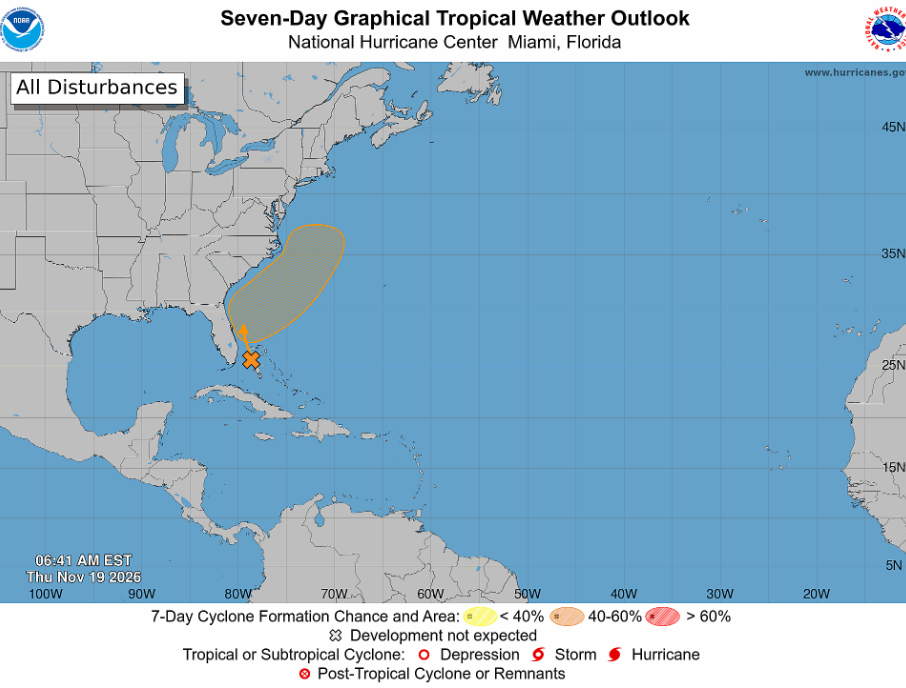
The National Weather Service in Raleigh said Thursday morning that a more active weather pattern could produce two episodes of coastal low-pressure development, bringing chances for rain to central North Carolina late this weekend and again around the middle of next week.
Forecasters also continue to monitor a non-tropical low expected to form near the northern Bahamas. That system could potentially develop tropical or subtropical characteristics, although its eventual track remains uncertain.
The Flat River feeds Lake Michie, while the Little River feeds Little River Reservoir. A widespread soaking over those watersheds could finally slow or reverse the reservoir decline. Rain falling primarily along the coast or elsewhere in the Triangle might do comparatively little.
Stage 2 remains in effect
Durham remains under mandatory Stage 2 water restrictions.
Spray irrigation with city water remains prohibited. Hand watering, drip irrigation, and tree or shrub watering bags are still allowed. Vehicle washing with city water is prohibited outside qualifying commercial or institutional car washes, and most washing of hard surfaces remains prohibited.
The city has not moved to Stage 3.
But the numbers continue to move in that direction: reservoir storage has fallen from 33% on Nov. 1 to 27% as of Nov. 17, while easily accessible supply has fallen from 83 days to 76 days over the same period.
Get Connected

- Send email to your neighborhood news guy: wes.platt@southpointaccess.news
- Follow on Threads.
- Connect on Instagram!
- Join our Discord community
- Join the Southpoint Access subreddit!
 Wes Platt

🤝 Support Our Sponsors
Local journalism in South Durham survives thanks to the generous businesses and organizations that make this work possible. 🧭
By supporting these sponsors, you’re helping Southpoint Access continue to deliver trusted, hyperlocal news and resources for our community - from school updates to neighborhood stories that keep South Durham connected.
Want to become a sponsor? Sign up here!
💛 Shop local. Hire local. Support those who support Southpoint Access.