
Durham slips back into severe drought as reservoirs fall to 43%
Durham still reports 96 days of readily accessible water, but Lake Michie and Little River Reservoir continue to fall. Stage 2 restrictions remain in effect.

 Wes Platt
Durham’s reservoirs fell to 43% full as of Oct. 1, while the city’s drought classification worsened from moderate to severe.
The city still estimates that it has 96 days of readily accessible reservoir water. That figure hasn’t changed since the Sept. 22 update, but it doesn’t mean the reservoirs have stopped shrinking.
Lake Michie and Little River Reservoir both continued to fall, and combined storage dropped from 45% on Sept. 22 to 43% on Oct. 1.
Durham remains under mandatory Stage 2 water restrictions.
By the numbers
- 43%: Combined reservoir storage, down from 45% on Sept. 22.
- 96 days: Estimated readily accessible water remaining, unchanged from Sept. 22.
- 160 days: Total estimated supply when less accessible water and Teer Quarry are included, up from 158 days.
- 27.22 million gallons per day: The 30-day average demand placed on Durham’s reservoirs, down from 28.14 million gallons per day on Sept. 22.
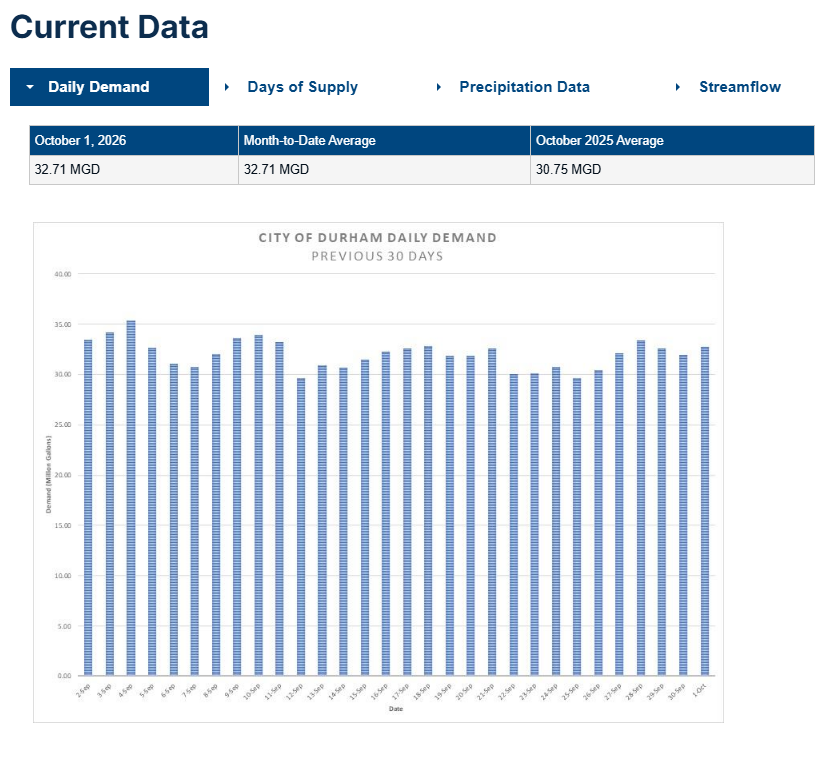
- 32.71 million gallons: Durham’s total water demand on Oct. 1.
Why did the supply estimate rise while the lakes fell?
The city reports 160 total days of supply, including:
- 96 days of readily accessible reservoir water.
- 44 days of less accessible water below the intake structures.
- 20 days of emergency storage in Teer Quarry.
That total is two days higher than the Sept. 22 estimate, even though the reservoirs hold less water.
The difference appears to come from lower average demand, not an increase in stored water. Durham calculates its days of supply using a 30-day running average of demand on the reservoirs. That average fell from 28.14 million gallons per day on Sept. 22 to 27.22 million gallons per day on Oct. 1.
When daily demand falls, the available water is projected to last longer. The estimate can rise even while the reservoirs continue to lose water.
In other words, 160 days is a planning estimate, not a countdown or a sign that Durham’s water supply has recovered.
Both reservoirs continued to fall
Lake Michie stood at 331.57 feet above mean sea level on Oct. 1. That was 9.43 feet below its full elevation of 341 feet and 0.27 feet lower than on Sept. 22.
Little River Reservoir stood at 339.66 feet, 15.34 feet below its full elevation of 355 feet and 0.44 feet lower than on Sept. 22.
Some rain reached both reservoirs during the closing days of September. Lake Michie’s year-to-date rainfall total rose by 0.60 inches between Sept. 22 and Oct. 1, while Little River’s rose by 1.10 inches.
That rain wasn’t enough to reverse the decline in lake levels.
Durham moves into severe drought
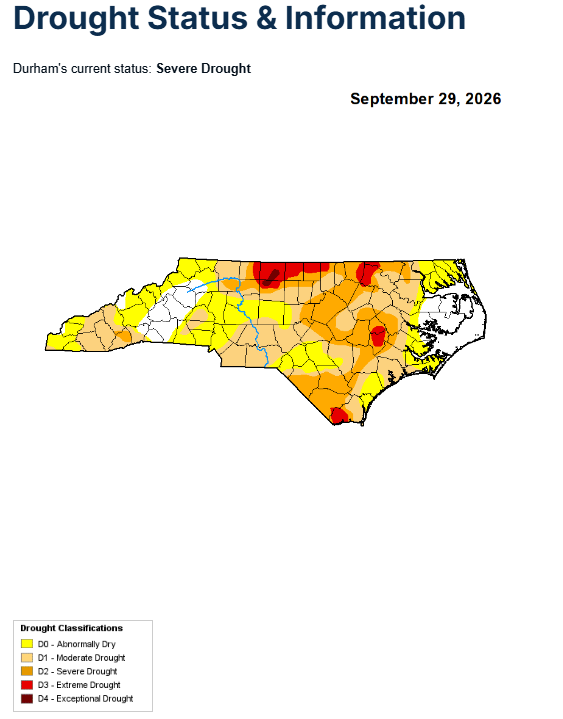
Durham has slipped back into severe drought after improving to moderate drought in September. Conditions remain better than they were in June, when Durham County was classified as being in exceptional drought, the highest category.
The drought classification and Durham’s water-shortage response aren’t the same measurement. The drought map reflects broader conditions, while the city’s response stage considers reservoir elevations, demand, treatment capacity, intake access, purchased-water availability, and supply modeling.
That's why Durham can move into severe drought while remaining under Stage 2 restrictions rather than automatically advancing to Stage 3.
Demand starts October above last year’s average
Durham used 32.71 million gallons of water on Oct. 1. That was nearly 2 million gallons more than the October 2025 daily average of 30.75 million gallons.
One day doesn’t establish a monthly trend, but the opening figure reinforces the need for continued conservation while reservoir levels fall.
Stage 2 restrictions remain in effect
The restrictions apply to City of Durham water customers, but not residents who use private wells.
Under Stage 2:
- Spray irrigation with city water is prohibited, including automatic systems and hose-end sprinklers.
- Hand watering, drip irrigation, soaker hoses, and tree or shrub watering bags are allowed.
- Residents can’t use city water to wash vehicles at home. Commercial and institutional car washes are allowed.
- City water can’t be used to clean driveways, sidewalks, decks, or building exteriors except for health and safety reasons or before painting.
- Pools can receive only enough water to replace evaporation or spillage and keep chemical systems operating.
- Restaurants should serve drinking water only when customers ask for it.
Suspected violations can be reported through the city’s online form or by calling Durham One Call at 919-560-1200.
Get Connected

- Send email to your neighborhood news guy: wes.platt@southpointaccess.news
- Follow on Threads.
- Connect on Instagram!
- Join our Discord community
- Join the Southpoint Access subreddit!
 Wes Platt
🤝 Support Our Sponsors
Local journalism in South Durham survives thanks to the generous businesses and organizations that make this work possible. 🧭
By supporting these sponsors, you’re helping Southpoint Access continue to deliver trusted, hyperlocal news and resources for our community - from school updates to neighborhood stories that keep South Durham connected.
Want to become a sponsor? Sign up here!
💛 Shop local. Hire local. Support those who support Southpoint Access.





![[SoDu Crime Watch] Seven people face serious charges in South Durham Crime Watch](https://storage.ghost.io/c/50/33/50334374-93a7-4cf9-ba69-d7d51c63be2a/content/images/size/w600/2026/07/crimewatch--1-.png)